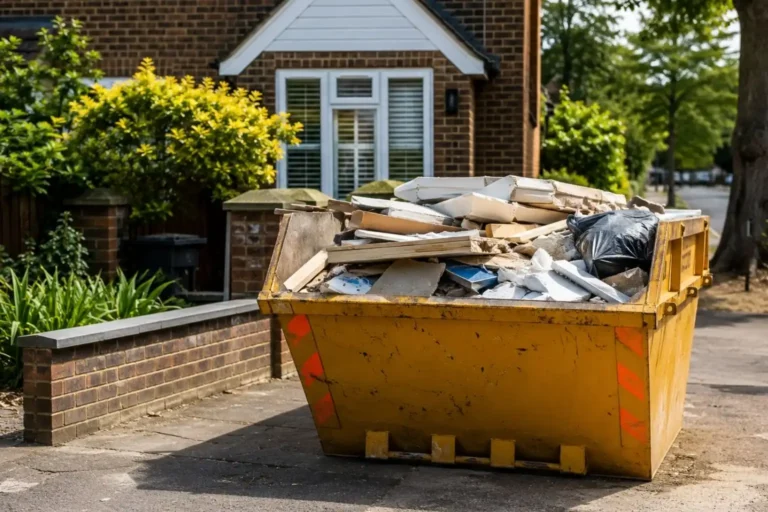
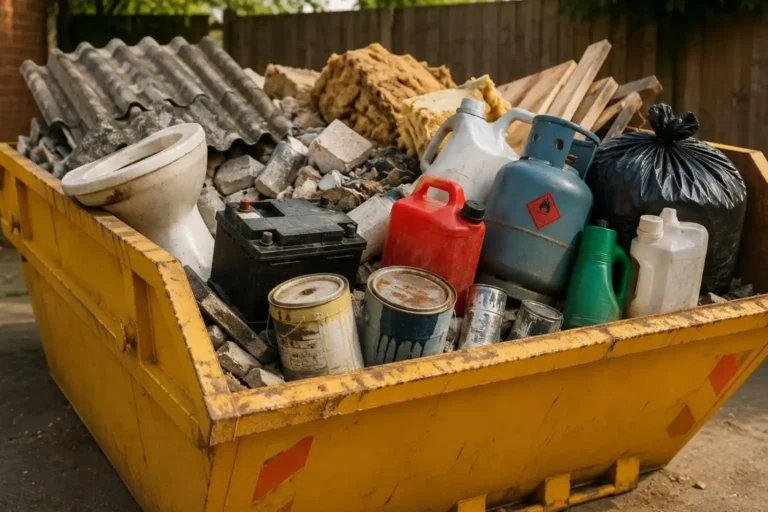
Clearing out a home, ripping out an old kitchen, or running a busy building site all create the same headache: far more waste than your wheelie bin could ever handle, and nowhere obvious to put it. It’s a bigger problem than most people realise. According to the UK government’s waste data, the UK produces more than 200 million tonnes of waste every year, with construction, renovation, and household clear-outs accounting for the largest share.
Hiring a skip is the simplest, most cost-effective way to deal with that waste, but only if you know what you’re actually allowed to throw in. Put the wrong items in, and you risk a refused collection, extra charges, or even a fine. So, what exactly can you put in a skip, and what needs to go somewhere else?
What Is a Skip, and What Is It For?
A skip is a large, open-topped container that’s delivered to your property and collected once it’s full, designed to take general, non-hazardous waste in one go. Skip hire is popular across the UK for home clearances, renovations, garden projects, industrial units, and commercial sites because it’s quick, convenient, and removes the need for endless trips to the tip.
Both residential skip hire and commercial skip hire work the same way and follow the same rules. The difference usually lies in the volume and type of waste materials, not in what’s allowed. As a rule of thumb, if waste is solid, inert, or general rubbish, and it isn’t hazardous, liquid, or electrical, it can usually go in.
In Lancashire and across the North-West, with its mix of older terraced housing, steady renovation work, and active construction, choosing the right skip and knowing the rules saves time and money. At Horrocks Waste, we provide reliable skip hire and waste management services for homeowners, builders, and businesses, helping you dispose of waste responsibly and legally.
What Can You Put in a Skip?
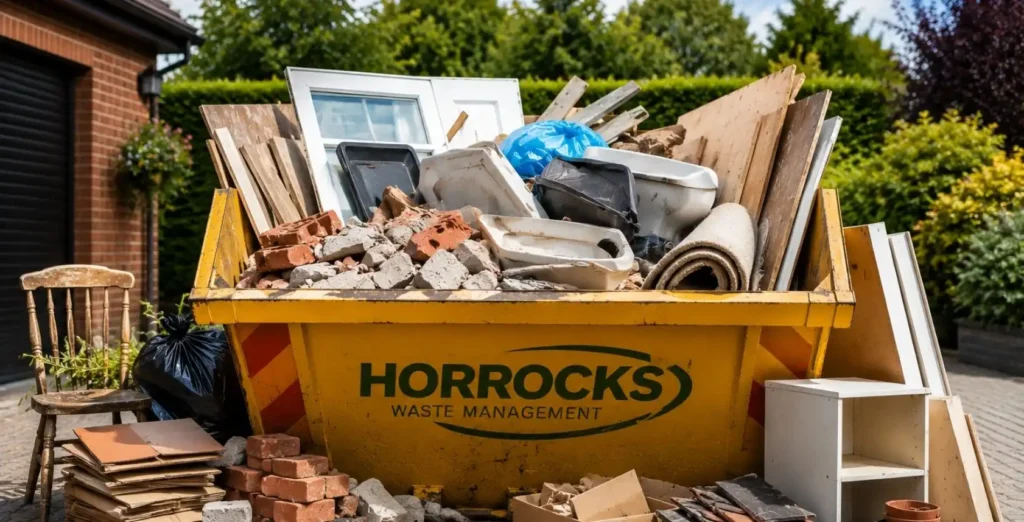
Most everyday waste is perfectly acceptable. Here’s what typically goes in a general waste skip:
- General Household Waste: Non-recyclable rubbish, packaging, old toys, carpets, textiles, and most hard plastics are all fine. A general waste skip is the simplest option for a mixed home clear-out where you’ve got a bit of everything.
- Garden & Green Waste: Soil, turf, grass cuttings, hedge trimmings, branches, and old plants can all go in. Garden and green waste like this is fine, but remember that soils and turf are heavy, so they can quickly reach a skip’s weight limit during loading.
- Soil, Rubble & Hardcore: Bricks, broken concrete, tiles, paving, rubble, and stone are accepted. Because these waste materials are so dense, a smaller skip is often the right call rather than a large one.
- Wood & Timber: Floorboards, skirting, pallets, and old untreated wood and furniture frames are fine. Treated or chemically preserved wood is the exception, which we cover below.
- Metal & Furniture: Pipes, radiators, railings, scrap metal, sofas, tables, and wardrobes are all accepted. Operators usually sort scrap metal out for recycling, so it rarely ends up in landfill.
How to Choose the Right Skip Size?
Picking the right size skip is half the battle. Too small and you’re paying for a second collection; too big and you’re paying for space you can’t fill. Our container range covers everything from mini to maxi skips, so here are the most common skip sizes:
- Mini Skip: Compact and ideal for small, heavy loads.
- Capacity: 2 to 3 cubic yards (around 25 to 35 bin bags)
- Typical cost: around £80 to £140 (North-West estimate)
- Best for: Small home and garden clear-outs
- Builders’ Skip: The most popular size for renovation and construction waste.
- Capacity: 6 to 8 cubic yards (around 65 to 85 bin bags)
- Typical cost: around £180 to £320 (North-West estimate)
- Best for: Home renovations and mixed building waste
- 10 Yard Skip: A larger option for bulky but lighter waste. A 10 yard skip hire is the go-to choice for big residential clear-outs where you have plenty of volume but not heavy rubble.
- Capacity: 10 cubic yards (around 100+ bin bags)
- Typical cost: around £260 to £420 (North-West estimate)
- Best for: Full house clearances and large residential skip hire jobs
- 40 Yard Skip (Roll-on Roll-off): A high-capacity container for ongoing, high-volume, industrial work. The 40 yard skip suits factories, warehouses, and large construction sites, and pairs well with regular commercial skip hire.
- Capacity: 40 cubic yards (bulky, lightweight waste)
- Typical cost: around £350 to £550 (North-West estimate)
- Best for: Commercial and large construction sites
Heavy waste materials like soil and rubble are limited by weight, not space, so a smaller general waste skip is often correct even for a big-looking pile. If you’re unsure whether you need a builders’ skip, a 10 yard skip hire, or a 40 yard skip, our friendly team can advise on the most suitable container for your waste disposal needs. Horrocks Waste can size both residential skip hire and commercial skip hire jobs across Lancashire and the North-West.
Do You Need a Skip Hire Permit?
If your skip sits on your own driveway, you won’t need a permit. But if it has to go on the road or public highway, you’ll need one of the skip hire permits issued by your local council. Don’t worry, we can arrange the hire permits for you and advise on placement and access so the process stays hassle-free. We’ll also make sure each skip is positioned safely, with the right security and lighting where the council requires it.
What You Can’t Put in a Skip?
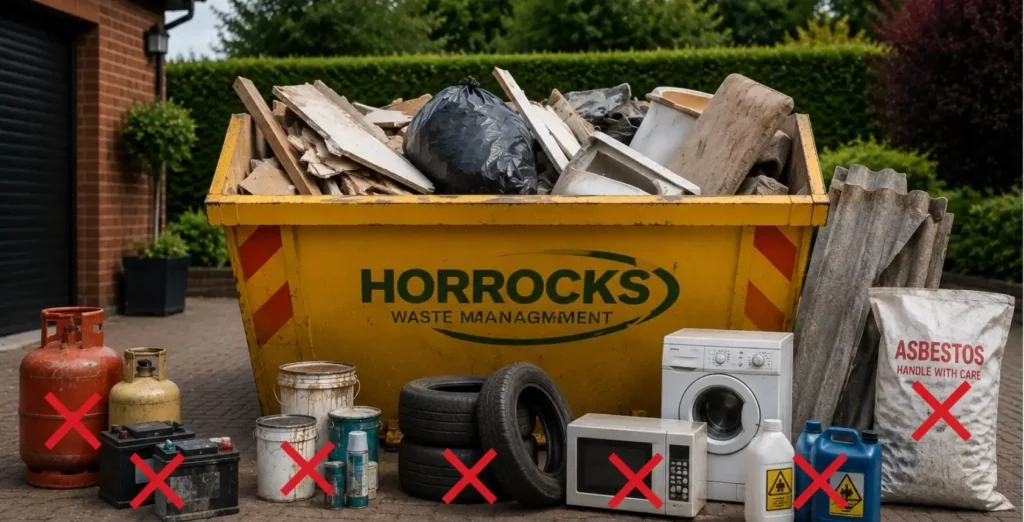
Some items are banned because they’re hazardous, prohibited from landfill disposal, or require a separate waste stream. These restricted waste streams must be kept out of a general skip, or you risk a refused collection, extra charges, or a fine under your Duty of Care. Keep these out:
- Asbestos: this hazardous waste releases harmful fibres and needs licensed specialist removal.
- Electrical items (WEEE): fridges, freezers, TVs, and white goods must go to WEEE recycling or a retailer take-back.
- Batteries: leak corrosive chemicals, so use battery recycling points.
- Paint, oils, and liquids: liquid and chemical waste contaminates the load, so take it to a hazardous waste facility.
- Gas bottles and aerosols: pressurised, so they pose a fire and explosion risk; return them to the supplier.
- Tyres: banned from landfill, so take them to a tyre retailer or recycler.
- Plasterboard (mixed in): gypsum can’t mix with general waste because it releases hydrogen sulphide gas as it breaks down, so it needs its own skip.
- Treated or contaminated wood: creosote-treated timber and railway sleepers are hazardous and need a separate route.
Get Expert Skip Hire from Horrocks Waste
Knowing what can and can’t go in a skip protects your project, your wallet, and the environment. Whether you need a one-off general waste skip for a weekend clear-out, residential skip hire for a full renovation, or regular commercial skip hire for a busy site, the key is matching the right skip to the right waste materials.
At Horrocks Waste Management, we make waste removal simple. Our skip hire covers everything from a mini skip to a 40 yard skip for commercial and industrial projects, all at competitive prices, with fast delivery and environmentally friendly disposal that keeps as much as possible out of landfill. Our friendly team can advise on the right size skip, arrange your permits, and handle everything from site access to collection, so the job stays hassle-free from start to finish. Use our online booking for an instant quote, or call 01204 843372 / email bookings@horrockswaste.co.uk.
Frequently Asked Questions About What Can You Put in a Skip
Can you put clothes in a skip?
Yes, clothes and textiles can go in a general waste skip without any problem. That said, wearable clothing is far better donated to charity, and worn-out textiles can go to a textile recycling bank, which keeps them out of landfill. If you’re clearing a wardrobe during a house move, separating the good from the ruined also saves valuable space in your skip.
Can you put household waste in a skip?
Yes. General, non-hazardous household waste, such as packaging, broken furniture, old toys, and carpets, is exactly what a skip is for. Just keep the restricted items out: electricals, batteries, paint, and anything hazardous. For a mixed clear-out, a general waste skip is usually the easiest choice.
Can you put food waste in a skip?
It’s best avoided. Skips aren’t designed for food or organic waste; it rots quickly, attracts pests and vermin, and can cause your load to be rejected. Small amounts mixed in with general household rubbish are usually tolerated, but any significant food waste should go to your council’s food or garden waste collection instead.
What’s not allowed in a skip?
The main banned items are asbestos, electrical goods (WEEE), batteries, paint, oils and liquids, gas bottles and aerosols, tyres, fluorescent tubes, and clinical waste. Plasterboard also can’t be mixed with general waste and needs its own skip. Putting any of these in a standard skip can lead to a refused collection or a fine, so it’s always worth checking before you load up.