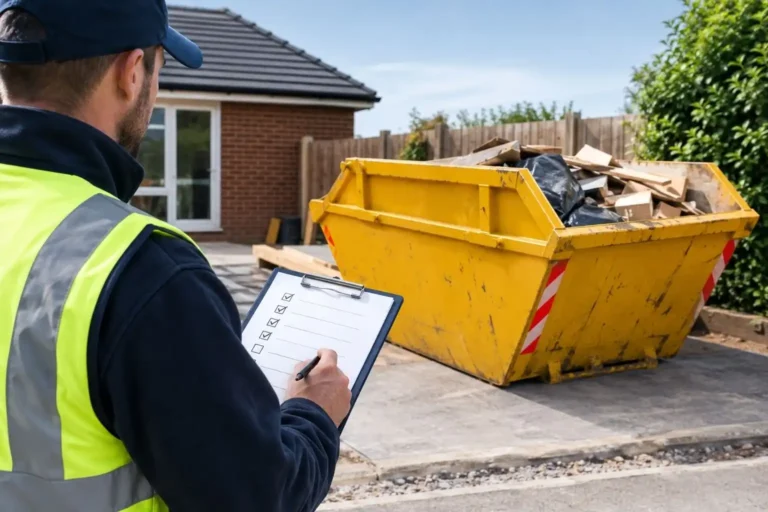
An open skip on a driveway or public road can quickly become a dumping point for waste that is not yours. Passers-by may drop bags into it, remove items, or add materials from their own projects, leaving you responsible for unwanted waste and potential extra disposal costs. According to the Department for Environment, Food & Rural Affairs (Defra), England recorded 1.26 million fly-tipping incidents, with 37% occurring on highways such as roads and pavements.
With so much fly-tipping taking place on public highways, an open skip in an accessible location can become an easy target for unwanted waste. So if an open skip could leave you dealing with unwanted waste, when is it worth choosing a lockable skip?
What is a Lockable Skip
A lockable skip is a steel skip fitted with a hinged lid, secured by a heavy-duty padlock through a hasp or a built-in locking bar. Lid and body share the same gauge of steel, so a closed unit is as solid as the skip underneath. The same product sells under several names. Enclosed skip, closed skip, covered skip and skip with lid all point to the same object, and a lockable skip bin is that product again under a different label.
One operator’s enclosed skip and another’s skip with lid can differ in the locking arrangement, so check the specification rather than the name. Loading happens through the lid, which lifts or swings clear, or a drop-down side door on some designs.
For jobs that need a lid, we run two lockable skip sizes, a narrower range than the open fleet:
- 8 yard lockable skip: domestic refits, plumbing work and mixed construction waste.
- 14 yard lockable skip: strip-outs and larger refurbishment programmes.
When To Use A Lockable Skip: Placement, Duration And Load

The decision comes down to four things: where the skip stands, how long it stands there, what goes into it, and who else has a say over the site.
Roadside Placement Under Permit
Any container reachable from a pavement is reachable by anyone using that pavement. Highway placement also brings a council permit, lighting and markings, which raises how visible the unit is at street level. On a terraced street with limited off-road parking, a roadside position is often the only option available.
For household refits and clearances of this kind, our residential skip hire covers the standard sizes, and an 8 yard lockable skip is the usual choice once the container goes on the road. Foot traffic past the unit carries on through the night, and nothing in a permit restricts who can reach into it.
Shared and Multi-Occupancy Sites
Flats, HMOs, retail parks, business parks and industrial estates all put a container inside a boundary that encloses a large number of other occupants. The skip is off the street, but that does not make it true private land when other residents or tenants can still get to it.
In a shared yard, a padlock is the only reliable way to keep a hired container single-tenant for the length of the job. It also helps prevent unauthorised access by other residents, tenants, or visitors. For office moves, tenant fit-outs and estate work of this kind, our commercial skip hire covers both open and enclosed options, and enclosed skip hire is often the suitable choice.
Schools, Care Homes and Public Sites
Schools, colleges, nurseries, care homes and healthcare sites raise a concern that runs past cost. An open container on a site used by children or vulnerable adults is a climbing hazard and a route to broken material, exposed fixings and discarded glass. A lockable skip is also a good option on sites used by vulnerable people because it helps prevent contact with discarded materials.
Summer holiday refurbishment work is the clearest example: reduced staffing, an active site, and periodic public access across several weeks. A lockable skip removes the climb-in risk entirely between working hours, which is easier to evidence in a site risk assessment than fencing or extra supervision.
Nights, Weekends and Long Hires
Risk is a function of unattended hours rather than total hire days. Lockable units are also useful for events or other temporary public-facing setups left unattended overnight or over a weekend. A container delivered on a Friday and collected on a Tuesday spends the greater part of its hire with nobody watching it.
Multi-week and phased programmes compound the same effect, because a skip that sits at a known address for a month becomes a local landmark, and that is the point at which casual tipping tends to start. Counting the unsupervised hours in your hire window gives a clearer read on the decision than counting the days.
Loads with Scrap Value
Copper pipe, lead flashing, cable, brass fittings, cast iron and stainless steel all come out of ordinary jobs. Rewires, roofing work, bathroom replacements and boiler swaps generate loads that can attract theft or tampering, and a lid helps prevent that risk.
Once material has left an open container overnight, there is no realistic route to getting it back, and waste awaiting collection is rarely treated as insured stock. A lid takes the load out of the category of material that can be lifted from a pavement in two minutes.
Records and Branded Stock
Office clearances, professional practices and medical premises generate paper records that carry a data protection exposure long after they reach the skip. Retail and hospitality sites disposing of branded stock, uniforms or packaging carry a separate problem.
Recovered stock has a habit of reappearing for sale, and it is hard to trace once it does. Both stand up as reasons on their own, with no theft concern attached. Closing the container is a simpler control than shredding or defacing everything before it goes in.
Rain and Weight Limits
Weather-related issues such as rain and wind are easy to underestimate with open containers. Soil, sand, plasterboard, gypsum, timber, carpet and cardboard all absorb water. Enclosed skips are weatherproof and help keep waste dry. Every skip carries a stated weight limit written into the hire agreement.
A load that sits open through several days of rain can pass that limit without a single extra item going in. At that point it may be refused for lifting until material comes out. Our terms and conditions set out the weight limits that apply to each container. A lid helps contain lightweight debris and keeps the load at the weight you put in.
Site Rules, Waste Management and Insurance
On managed construction sites, security provisions are frequently written into the site rules or the insurance schedule, and an unsecured waste container on a site with controlled access is treated as a weak point. Principal contractors running CDM programmes tend to hold waste storage to the same standard as plant and materials.
If your principal contractor specifies secure waste storage, lockable skip hire satisfies the requirement directly. On specialist jobs, lockable units can also be used for asbestos clearance where the waste stream and handling arrangements require it, and an 8 yard lockable skip covers a typical fit-out volume. Confirm it before delivery rather than swapping the container mid-hire.
How a Lockable Skip Loads Differently
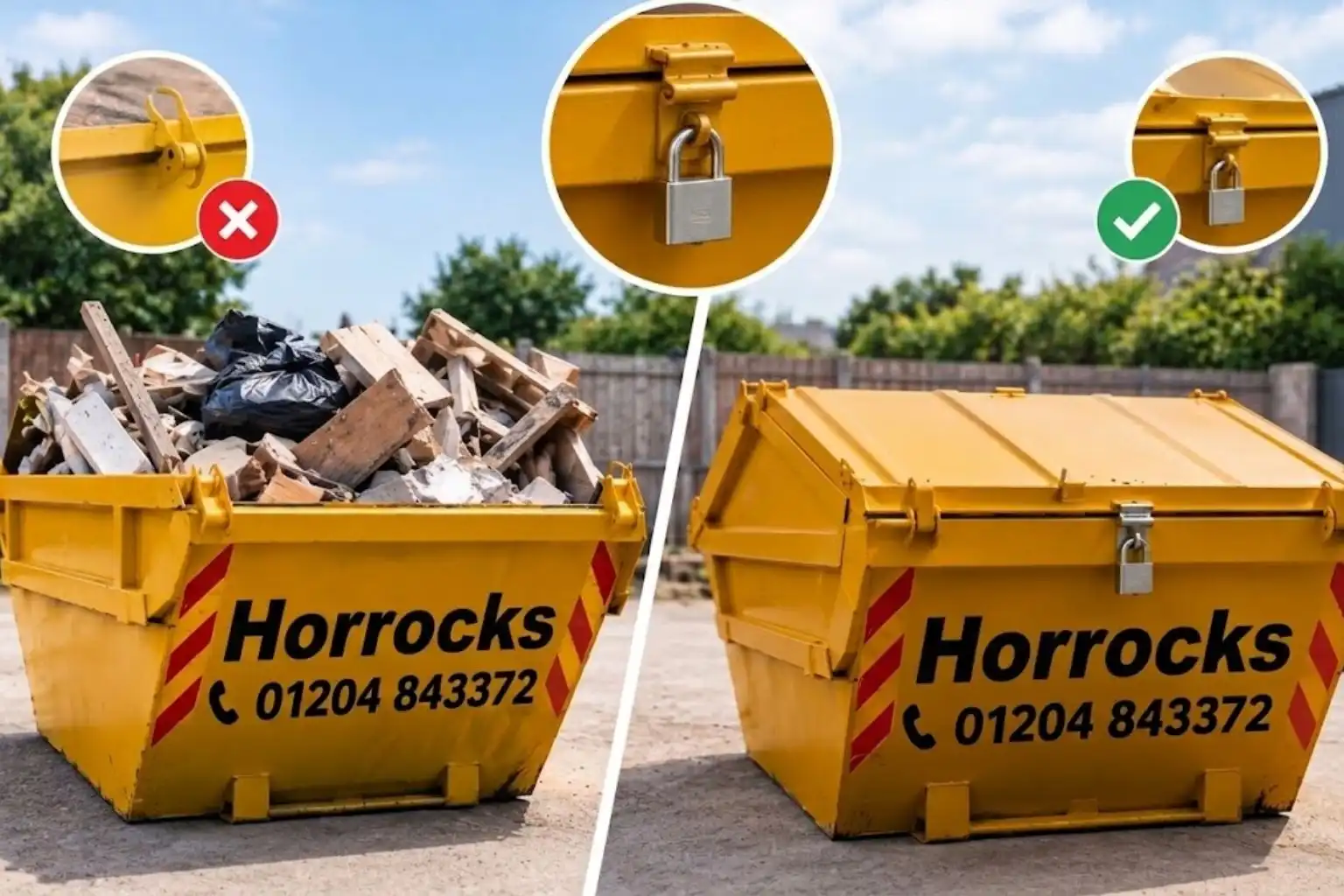
An enclosed skip is not a free upgrade, and the trade-offs are worth knowing before delivery day.
- The load cannot be heaped: A skip with lid has to shut, so usable volume is capped at the lid line. An 8 yard lockable skip holds less than an open container of the same nominal size, so compare lockable skip sizes against the open range and size up.
- Bulky items are harder to place: Long timber, internal doors, mattresses and furniture that would sit proud of an open skip may not go under a lid at all.
- Clearance matters: The lid needs headroom and swing space, so ensure the placement area stays accessible and unobstructed for delivery, loading, locking and collection. A lockable skip bin pushed tight against a wall, under a carport or beneath low branches becomes difficult to load and difficult to lock.
- Availability is tighter: Fewer enclosed units are in circulation than open ones, and enclosed skips may be available from fewer depots or in smaller numbers, which leaves less flexibility on same-day and next-day delivery. Book lockable skip hire further ahead than you would an open container.
Work these out when you book rather than when the lorry arrives, and a lid costs you nothing beyond a bit of forward planning.
Book Secure Skip Hire with Horrocks
One thread runs through every condition above: the main advantage of a lid is what it does during unattended hours. A driveway skip collected next morning barely opens that window. A roadside skip standing through two weekends of a strip-out leaves it open for hundreds of hours. Add up the unattended time, weigh what is going into the container, and knowing when to use a lockable skip stops being guesswork. Where the exposure is real, an enclosed skip closes it. Where it is not, an open skip does the job with fewer restrictions.
If you’re looking for secure skip hire across Lancashire and Greater Manchester, Horrocks Waste Management provides licensed waste collection, waste disposal, lockable skip hire, and practical advice on matching a lockable skip bin and the right lockable skip sizes to your project. We can also help you choose the most suitable option for your site and schedule. Contact our team today on 01204 843372 or at bookings@horrockswaste.co.uk for a free quote and expert guidance.
Frequently Asked Questions About Lockable Skip
How long can I keep a lockable skip on hire?
Our hire periods are set when you book, and we apply the same terms to lockable and open containers alike. Extensions are straightforward for us to arrange, so contact us before the collection date rather than after it. Duration is worth planning around on a locked container.
The longer a skip stands at an address, the more familiar it becomes to everyone passing, and that is the point at which third-party tipping tends to begin. On phased programmes, a shorter hire with a mid-project exchange often works better than one long booking. Tell us your expected timescale and we will confirm what suits the job.
Do I still need a council permit if the skip is locked?
Yes. A skip hire permit governs where our skip stands, not how it is secured. Any container we place on a public road, pavement or verge typically needs a skip hire permit, and charges can vary by local authority, along with the lighting and markings the authority specifies, lid or no lid.
A skip sitting entirely on private land needs no permit either way. Permits take time to process and, in some instances, councils apply minimum notice periods or additional conditions, so factor that into your booking rather than the delivery date. We handle permit applications on our customers’ behalf where the local authority allows it. Tell us your intended position and we will confirm what the placement requires.
Can I swap an open skip for a lockable one partway through a project?
Yes, and we handle it as a standard exchange rather than a new hire. We collect the open container and deliver an enclosed unit in its place, which works best timed with a lift you had already planned so your site is not left without a skip.
Bear in mind that waste already loaded transfers into our new container only if it fits under the lid, since an enclosed unit caps usable volume at the lid line. Anything heaped above that has to be redistributed. Give us a few days’ notice where you can, because we hold fewer lockable units than open ones and availability moves quickly.
Can a lockable skip take the same waste types as an open skip?
Yes. The lid changes who can reach your waste, not what we are permitted to take, so the same restrictions apply to both because the skip remains suitable only for permitted waste streams. The same restrictions apply to both: asbestos, tyres, fridges and freezers, plasterboard, batteries, paint and electrical equipment all need separate disposal arrangements and cannot go into a general load.
Hazardous waste needs separate handling and disposal arrangements. Some waste types, including asbestos, require specialist waste management routes rather than general skip use. Plasterboard is the one that catches our customers out on refurbishment work, since it turns up in volume and looks like ordinary building waste. A locked lid does help with compliance in one respect, though, because it stops anybody adding a restricted item to your container without your knowledge. Confirm your expected mix and we will advise on the right route.